

Magnesium Complex


Magnesium Complex
Magnesium Complex
- Home
- Brands
- Progressive Labs
- Magnesium Complex
- Home
- Categories
- Magnesium
- Magnesium Complex
SKU: 1038
Brand: Progressive Labs
Couldn't load pickup availability
Description
Description
Magnesium is a mineral that is abundant in the body, andis a cofactor in more than 300 enzyme systems. These enzyme systems regulate many diverse reactions within the body including protein synthesis, muscle and nerve function, blood glucose control and blood pressure regulation.‡
Magnesium is required for energy production and supports the structural development of bone and is required for the synthesis of DNA, RNA and glutathione. Magnesium also plays a role in processes important to nerve conduction, muscle contractions and normal heart rhythm.‡
Magnesium deficiency is not uncommon in the United States, and is particularly common among African Americans. The overall prevalence of magnesium deficiency in African Americans (predominantly female) was 20% based on a study of urban African Americans. Magnesium deficiency has also been noted in people with a history of alcoholism (6 times more likely), in people with chronic diarrhea, and 2/3 of people in intensive
care.‡
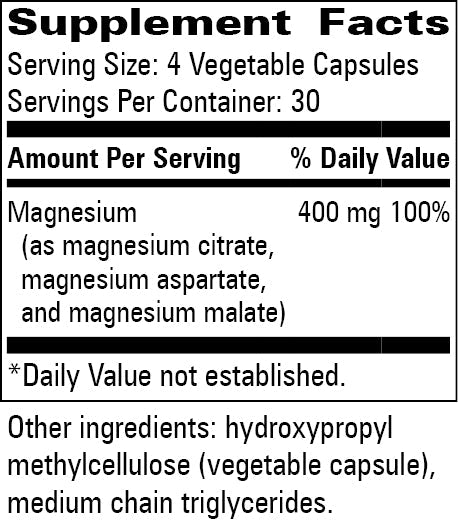
Magnesium Complex combines three powerful, “energetic” forms of magnesium – citrate, aspartate and malate – each molecule chelated to substrates of the Krebs cycle or to other energy-producing components found in healthy foods:‡
Citric Acid, found in tomatoes, oranges, lemons, and limes, is important as an intermediate in the citric acid or Krebs cycle, which is core to healthy human metabolism.‡
Aspartic Acid occurs in many vegetables including sprouting seeds and avocados, and is a critical component of energy production at the cellular level.‡
Malic Acid is formed in metabolic cycles in the cells of plants and is partly responsible for the stimulating, refreshing experience of biting into a juicy apple or cherry. Malic acid provides cells with energy via the Krebs cycle and provides building blocks for the formation of amino acids.‡
‡ These statements have not been evaluated by the Food and Drug Administration.
These products are not intended to diagnose, treat, cure or prevent any disease.
Ingredients
Ingredients

Warning: If you are pregnant or lactating woman, have any health conditions, or are taking any medication, make sure to consult your healthcare provider prior to use.
Reviews
Reviews

Magnesium is a mineral that is abundant in the body, andis a cofactor in more than 300 enzyme systems. These enzyme systems regulate many diverse reactions within the body including protein synthesis, muscle and nerve function, blood glucose control and blood pressure regulation.‡
Magnesium is required for energy production and supports the structural development of bone and is required for the synthesis of DNA, RNA and glutathione. Magnesium also plays a role in processes important to nerve conduction, muscle contractions and normal heart rhythm.‡
Magnesium deficiency is not uncommon in the United States, and is particularly common among African Americans. The overall prevalence of magnesium deficiency in African Americans (predominantly female) was 20% based on a study of urban African Americans. Magnesium deficiency has also been noted in people with a history of alcoholism (6 times more likely), in people with chronic diarrhea, and 2/3 of people in intensive
care.‡
Magnesium Complex combines three powerful, “energetic” forms of magnesium – citrate, aspartate and malate – each molecule chelated to substrates of the Krebs cycle or to other energy-producing components found in healthy foods:‡
Citric Acid, found in tomatoes, oranges, lemons, and limes, is important as an intermediate in the citric acid or Krebs cycle, which is core to healthy human metabolism.‡
Aspartic Acid occurs in many vegetables including sprouting seeds and avocados, and is a critical component of energy production at the cellular level.‡
Malic Acid is formed in metabolic cycles in the cells of plants and is partly responsible for the stimulating, refreshing experience of biting into a juicy apple or cherry. Malic acid provides cells with energy via the Krebs cycle and provides building blocks for the formation of amino acids.‡
‡ These statements have not been evaluated by the Food and Drug Administration.
These products are not intended to diagnose, treat, cure or prevent any disease.
Magnesium is a mineral that is abundant in the body, andis a cofactor in more than 300 enzyme systems. These enzyme systems regulate many diverse reactions within the body including protein synthesis, muscle and nerve function, blood glucose control and blood pressure regulation.‡
Magnesium is required for energy production and supports the structural development of bone and is required for the synthesis of DNA, RNA and glutathione. Magnesium also plays a role in processes important to nerve conduction, muscle contractions and normal heart rhythm.‡
Magnesium deficiency is not uncommon in the United States, and is particularly common among African Americans. The overall prevalence of magnesium deficiency in African Americans (predominantly female) was 20% based on a study of urban African Americans. Magnesium deficiency has also been noted in people with a history of alcoholism (6 times more likely), in people with chronic diarrhea, and 2/3 of people in intensive
care.‡
Magnesium Complex combines three powerful, “energetic” forms of magnesium – citrate, aspartate and malate – each molecule chelated to substrates of the Krebs cycle or to other energy-producing components found in healthy foods:‡
Citric Acid, found in tomatoes, oranges, lemons, and limes, is important as an intermediate in the citric acid or Krebs cycle, which is core to healthy human metabolism.‡
Aspartic Acid occurs in many vegetables including sprouting seeds and avocados, and is a critical component of energy production at the cellular level.‡
Malic Acid is formed in metabolic cycles in the cells of plants and is partly responsible for the stimulating, refreshing experience of biting into a juicy apple or cherry. Malic acid provides cells with energy via the Krebs cycle and provides building blocks for the formation of amino acids.‡
‡ These statements have not been evaluated by the Food and Drug Administration.
These products are not intended to diagnose, treat, cure or prevent any disease.
Take four vegetable capsules daily, with food.